salt

Pregnancy Toes – What Sugar Does to Feet

22.2K views

Pregnancy toes are really swollen feet and swollen toes. The name stuck in my mind because one of my daughter-in-laws is pregnant and I was sent a photo from her winter vacation in her flip flops in the snow and winter coat—she was not able to put her boots on because of her swollen feet (swollen even in the cold!).

I did not think much about it until she came to visit me yesterday and I noticed the flip flops and her chubby toes. She had “pregnancy toes” again she said. It then suddenly all became clear. I asked her: did you by any chance have any sugar today? And she said “as a matter of fact, yes!”

I reached for my salt pills that I use for my migraines as do all members in my migraine group on Facebook and handed her one. I really should have photographed what happened but I did not think the effect was going to be so fast and so big. Less than 15 minutes after she took the salt pill and a glass of water, her toes went back to normal. We ended up laughing it away. Had she known this, she could have worn her boots in the snow after all!

So what did her pregnancy toes have to do with sugar and salt you may ask? Previously, I quoted from the Harrison’s Manual of Medicine an important paragraph that I repeat here:

…serum Na+ falls by 1.4 mM for every 100-mg/dL increase in glucose, due to glucose-induced H2O efflux from cells. (page 4)

The above means glucose (part of sugar) and sodium (part of salt) are in inverse relationship. As you increase sugar, salt drops and water is sucked out of your cells by sugar like a giant Slurpee machine. The water then collects on the outside of your cells rather than the inside, thereby dehydrating your cells and at the same time make your body swell. Edema is often associated with too much salt, but in fact, it is too much sugar. Being always thirsty is associated with Type 2 Diabetes but it is also associated with not having enough salt in the body since without salt the cells cannot get hydrated.

In light of this fragile balance between sodium and glucose in the blood, are we treating pregnancy edema, gestational diabetes, and other maternity complications, the way we should? Consider that with pre-eclampsia (gestational hypertension), women are told not to eat salt. You can see what happens when we reduce sodium: glucose increases and we also induce an ionic imbalance. This ionic level imbalance is visible (like the swollen toes) and may lead to further complications. There are two problems that we are facing here: first if she does not eat salt, her sodium-potassium pumps cannot work–this may cause migraines and headaches as I often see in my migraine group. Secondly, as you saw the fragile balance between the see-saw action of glucose and sodium, if she stops eating sodium her glucose may increase, causing swelling. This is an interesting theory to ponder – one that merits research.

Sodium and Glucose Work Together

Salt breaks up in the body into sodium and chloride. Sodium attracts water and holds onto it inside the cells. It keeps chloride outside of the cells to ensure proper voltage and electrolyte balance with the aid of potassium. When you eat sugar, the glucose part of it removes the water from the cells via osmotic channels that are too narrow for the sodium ions to exit. Thus, one ends up with a ton of water outside the cells with sodium inside hugging a tiny amount of water. Swelling occurs as the water leaves the cells but remains between cells.

Given the inverse nature of glucose and sodium in the blood, if one is swollen as a result of too much sugar, eating salt will take the water back from sugar and move it back into the cells–as it did for my daughter-in-law’s pregnancy toes. What is important in this information is this:

  1. If you feel swollen after eating sweets, you need to eat salt and drink a bit of water to reduce your swelling.
  2. If you have Type 2 Diabetes or are hypoglycemic, eating a salty meal can give you a major sugar crash and land you in the hospital!
  3. Eating sugar of any quantity will dehydrate your cells and you and make you run to the toilet every 30 minutes.

Because glucose takes water out of the cells, the edema that follows increases extra-cellular water and causes swelling in the body. This extra-cellular water needs to be reabsorbed into the circulation for the kidneys to be eliminated. To be reabsorbed, sodium is necessary since without sodium, the cells cannot operate their voltage gated sodium pumps and so the gates cannot open to grab glucose to take it into the cells and to get the water back into the cells. I think you can already see the contradictions in the logic of reduced salt: the mom-to-be is told to not eat salt, this causes extra-cellular water and swelling, which needs salt to be reabsorbed into her cells for clearance by the kidneys but which she is not allowed to eat. This way ionic level balance is not possible and chain reactions may occur with negative consequences. She may have protein leaching into her urine, extra hard kidney work, and a whole other long chain of complex events may kick in to make pregnancy a rather unpleasant experience risking the health of the fetus.

The amount of extra-cellular water is very hard for the body to get back into circulation without salt and may take days, taxing the kidneys with the volume of water leaving and increasing pressure on the blood vessels from the outside, causing high BP. However, as the volume of water is leaving the body finally, this reduces blood pressure. When a pregnant woman’s blood pressure drops as a result of all that water leaving, the dehydrated blood cells carry less oxygen. This indicates reduced oxygen for both her and the baby.

By telling mothers to reduce salt intake, glucose increases, which increases blood pressure (BP) rather than reduces it. The similar phenomenon happens in gestational diabetes. In gestational diabetes (and gestational hypoglycemia as well) the sugar level is unstable and is either too high or too low, respectively. Should the mother-to-be eat a salty pickle (as cravings always dictate pickles), she may end up in a major sugar crash and in the hospital for immediate treatment.

The balance between sodium and glucose is very fragile and extremely quick changing as you could see on my daughter-in-law’s foot. Interestingly we now also know that salt does not increase blood pressure but sugar does and so a reduced salt diet automatically increases blood pressure because of the glucose and sodium inverse connection and sugar’s dehydrating properties. Reduced salt also increases triglycerides (Graudal, 2011), causing a lot of problems for people with preexisting heart conditions. So by reducing the salt intake of the mothers to be, are we creating diabetic mothers and/or babies? Babies have been born with diabetes 2!

Is it possible that we are giving the wrong advise to pregnant women about salt and sugar? It’s an interesting question to pose and further research is badly needed. Knowing that salt and sugar are in inverse proportion in the blood, one may suggest eating them together. In fact, eating them together is a much better idea than eating sugar alone. It is best to not eat sugar at all but if you must eat sugar, consider eating salt too.

Sources:

Effects of low sodium diet versus high sodium diet on blood pressure, renin, aldosterone, catecholamines, cholesterol, and triglyceride. Graudal et al., Cochrane Database Syst Rev. 2011 Nov 9; (11).

This article was published originally on Hormones Matter on February 15, 2015. 

We Need Your Help

More people than ever are reading Hormones Matter, a testament to the need for independent voices in health and medicine. We are not funded and accept limited advertising. Unlike many health sites, we don’t force you to purchase a subscription. We believe health information should be open to all. If you read Hormones Matter, like it, please help support it. Contribute now.

Yes, I would like to support Hormones Matter. 

Happy Ending to Migraines: The Benefits of Milk

19.1K views

Migraines and Electrolytes

In late June of 2015, I received a PM (personal message) on Facebook from a husband of a migraineur. The husband introduced himself and explained that his wife “suffered with migraines for 15 years (Oct. 2000) after hitting her head under a bathroom cabinet.” She had been through all kinds of typical migraine treatments – just about everything under the sun possible to try, including a neuronal stimulator placed in via surgery – but nothing has worked. As he was sitting in the hospital waiting for some results, he found me on Facebook and asked for help.

I have a standard questionnaire that I ask all migraineurs to fill and send the answers to me via PM so I can see what may be wrong. The first thing that hit me was that she was drinking 256 oz (32 glasses) water a day when the calculator suggested that her petite figure needed only 66 oz (just over 8 glasses) so something was terribly wrong. She also took a ton of medications, though the list he sent was already greatly reduced. Even with these medications, she suffered debilitating migraines every day.

The migraineur was Kristen Cassimatis. Her recovery was covered recently by a local television station on their news. You can watch it here: Raw milk helping woman relieve migraine pain.

What Do Electrolytes, Whole Milk, and Migraines Have in Common?

A lot actually. The very first article I published at Hormones Matter was on the importance of proper hydration to the body. Hydration is not water but a mix of electrolyte minerals with water, of which sodium and potassium (in proper balance) are the most important. An article I wrote somewhat later describes what excessive thirst means for the body and that sugar is really bad for you. Thus, if you look through some of the articles I published, you can see that a meal that is hydrating, contains no added sugar, has protein and some minimal carbs, electrolytes, and fat. Fat is good for you. I have also published several academic journal articles on the cause and treatment of migraine, based on statistical findings in the migraine group on Facebook.

I have not yet discussed fat and cholesterol in great detail but an article shall come about that in the near future. For now, since whole milk is full of saturated fat and cholesterol, I just want to mention a few important findings. It is important to note that over 70% of our brain is fat and 25% of all cholesterol in our body is found in our brain (1) in what is called the white matter where voltage transmitting axons are coated with cholesterol (myelinated). Thus, cholesterol and fat are important for us.

While there is a huge controversy over the benefit versus harm of saturated fats and cholesterol, more studies now show that saturated fats and higher levels of cholesterol are actually better for us, particularly for women. In fact, saturated fat is not associated with heart disease as suggested by many studies.

To add insult to injury, cholesterol is not actually made from fat but from acetoacetyl-CoA (2) by a 19-step process in the liver. We can choose to eat cholesterol but if we don’t eat enough, the liver has to make cholesterol. When we don’t eat cholesterol, the liver makes less cholesterol than each person’s optimal level (2). The only bad cholesterol our liver makes are triglycerides that do clog up arteries but they are made of sugar and under special circumstances. Thus, regardless in what stage studies are at now, something that every single cell is made of in our body – the membrane of each human cell is made of lipid bilayer – cannot possibly be bad for us: we are made of the stuff.

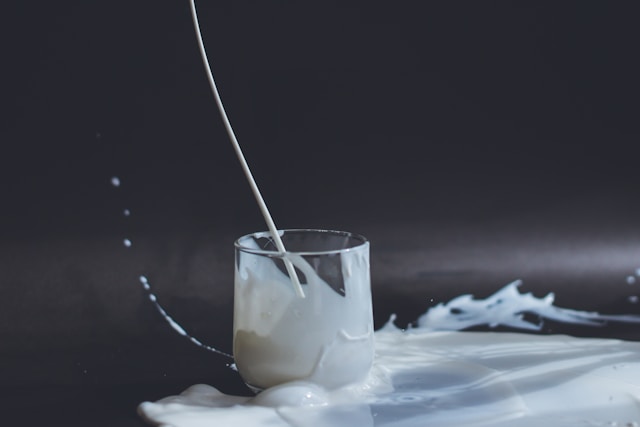
As in the story above, someone who feels the urge to drink a lot of water is usually not getting enough or the right balance of electrolytes. Moreover, the act of drinking too much water is harmful since it dilutes electrolytes. Drinking whole milk, which is full of electrolytes, on the other hand, is good for us migraineurs and others alike. Few people realize that milk is a great source of electrolytes, protein, and good cholesterol. Most of us were told from early on in our lives that milk is for cows and not people; milk is bad for us; it has puss in it; it causes puss; it makes one phlegm up; it makes us fat; it has too much fat; etc. We have been told not to drink milk, and as a result, many folks are having difficulty managing electrolyte and cholesterol balance.

I think that milk is a perfect food, assuming of course, that it is organic, whole milk, not treated with hormones and antibiotics, as in the story above. Raw milk is not legal everywhere so while drinking safe raw milk is healthier, it may not be available to everyone. Reduced fat milk does not have the benefits of whole milk and also contains added sugar and proteins that are not all that great for you. In fact, if you have no time to eat a meal, be it breakfast, lunch, or dinner, a glass of whole milk is an ideal replacement.

So, as Kristin recovered from her migraines and is also preparing to have her brain stimulator surgically removed, she joined the thousands of migraineurs who have joined our migraine community on Facebook. Enjoy Kristen’s story and join the several thousands who have been able to stop all their medicines and remained migraine free.

Sources

  1. Perlmutter D & Loberg K (2014) Grain Brain: The Surprising Truth About Wheat, Carbs, and Sugar – Your Brain’s Silent Killers (Hodder & Stoughton).
  2. Dr. Kendrick M (2007) The Great Cholesterol Con; The truth about what really causes heart disease and how to avoid it (John Blake Publishing, London, England) p 270.

We Need Your Help

More people than ever are reading Hormones Matter, a testament to the need for independent voices in health and medicine. We are not funded and accept limited advertising. Unlike many health sites, we don’t force you to purchase a subscription. We believe health information should be open to all. If you read Hormones Matter, like it, please help support it. Contribute now.

Yes, I would like to support Hormones Matter.

Photo credit: Photo by Anita Jankovic on Unsplash.

This article was published originally on May 25, 2016.

Hydration, Thirst, and Drinking Water

24.5K views

Most of us equate the expression “hydrate extra” with drinking more water but – unfortunately – this is incorrect. In any online dictionary “to hydrate” means to create “…a substance that is formed when water combines with another substance…” In other words, water alone is not a hydrating fluid but it must be combined with something to become one. We do not have water in our body on its own; we have a substance we call electrolyte. I wrote substantially on the topic of hydration, mixing water with minerals, as part of the protocol that prevents migraines. However, a new problem has surfaced: when to drink water? Several articles have recently published water drinking instructions on the internet. Most of these articles consider it bad practice to drink water when one is not thirsty and recommend drinking water only when thirsty. There are several serious flaws with this argument.

Sweat

The first flaw is that most research is aimed at athletes, but athletes are not representative of the majority of the population. Furthermore, athletes should not be drinking “water” to hydrate. Drinking water cannot be absorbed by cells without adequate sodium to hold onto it. When athletes sweat, the content of sweat is not water but electrolyte. Many sports drinks aim at re-hydrating athletes but their problem is their sugar or sugar substitute content, defeating the purpose — see how much sports drink one needs to drink to make up the content of sweat for an athlete. Then add up the sugar in a typical sports drink: 1 teaspoon of sugar is 4 grams of carbs. An average serving of a typical sports drink provides between 14 grams to 54 grams of carbs, all sugar, which converts to 3.5 to 13.5 teaspoons of sugar per serving. Drinking sugar substitutes is even worse because sugar substitutes fool the body like it is receiving glucose so insulin spikes but there is no glucose. This creates insulin overflow in the blood causing you to become hungry! Sugar substitutes may lead to obesity and metabolic syndrome. Drinking sports drinks with sugar substitutes actually reduces muscle energy.

Moreover, anything that converts to glucose in the body removes both water and sodium from the cells1 so drinking/eating sugar with sodium (salt is the form in which sodium is available to us) and water is worse than not drinking anything at all. Many athletes have smartened up and drink pickle brine rather than water. Pickle brine is great, assuming the brine is of salt and water and not vinegar. Vinegar is fermented ethanol (alcohol). Thus, drinking vinegar-processed pickles will dehydrate further. Look for pickles made with salt rather than vinegar.

Best Hydrating Fluid

Whole milk is an ideal hydrating fluid because it has a perfect electrolyte balance in sodium, potassium, water, blood sugar (lactose), calcium, phosphorus, magnesium, and protein. Whole milk is THE perfect electrolyte. Some athletes drink water and take salt pills (also called electrolyte pills). That is also a great option, particularly since they are easy to carry around and take when needed.

The second flaw in the argument of “drink water when thirsty” is that many people feel thirst after eating sugar when it is the least advisable to drink water. Since about half of sugar converts to glucose, and glucose pulls water and sodium out of the cells1, if one is thirsty after eating sugar and drinks water, the metabolic process will remove more water from the cells. This can cause edema. Although most articles today blame salt for causing edema, the opposite is true.

While sodium retains water inside the cell, glucose removes water and sodium from the cell and forces the water to be retained in extracellular space2. Eating salt when one has edema reduces edema by the sodium bringing water back into the cell. This was easily demonstrated by a previous article showing how this works.

The problem with most studies that blame salt on retaining water is that no studies have ever controlled for both salt and sugar at the same time in the same experiment. All studies I could find only looked at the effects of salt on the body regardless of the amount of sugar, water, or protein the subjects had consumed before the experiment. Since the body can easily be tipped out of balance and is never in a vacuum for a pristine controlled experiment, one cannot say with certainty that one element makes a particular change without looking at what else is affecting the body. No such studies exist except in my migraine group where we control for all variables. We found that being thirsty often means the person does not have enough salt to keep water where it belongs3. A migraineur should never drink water when she is thirsty, particularly not if carbohydrates were consumed.

The final problem with only drinking water when thirsty is the population of people who have diabetes 2; they are always thirsty. Being thirsty can be a sign of diabetes mellitus and not the need for more water.

Should You Wait Until You Are Thirsty Before You Drink?

Absolutely not, and for sure drinking water alone will not get you hydrated. How much water you should drink is a question I will address in another article. Drinking the minimum 8 glasses of water is a myth; people vary in size, age, and activity, implying that each person needs a different amount of water. Many online water calculators go into detail of weight, climate, activity, altitude, your health, pregnancy, nursing, etc. For each person the amount of water and thus hydration needed (not just water) will differ and for that hydration level you need to make sure you drink adequate amounts of water as part of your hydration protocol.

Sources

  1. Longo DL, Fauci AS, Kasper DL, Hauser SL, Jameson JL, Loscalzo J. Harrison’s Manual of Medicine 18th Edition. New York: McGraw Hill Medical; 2013.
  2. Millar T. Biochemistry Explained: A Practical Guide to Learning Biochemistry. Vol reprint edition: CRC Press; 2002.
  3. Stanton, Angela A. Fighting The Migraine Epidemic: A Complete Guide: How To Treat & Prevent Migraines Without Medicine

We Need Your Help

More people than ever are reading Hormones Matter, a testament to the need for independent voices in health and medicine. We are not funded and accept limited advertising. Unlike many health sites, we don’t force you to purchase a subscription. We believe health information should be open to all. If you read Hormones Matter, and like it, please help support it. Contribute now.

Yes, I would like to support Hormones Matter.

The Truth About Salt

23.2K views

When we salt our food, we rarely think of salt as a crucial aspect of our physiology. In particular, we think it has absolutely nothing to do with anything other than taste and we certainly do not think of hormones. In this short post, I would like to clarify a few myths about salt and salt types and hint at their importance and hormonal connection.

The Myths of Designer Salts

Myth #1 sea salt versus table salt. There are hundreds of posts on the Internet about the benefits of sea salt over table salt. I would like everyone to know that there is only one salt on planet earth: sea salt. The fact that it may be called table salt simply suggests that some time ago it was clearly understood by all that all salt came from the sea. There was no need to place the word “sea” in front of salt; we all knew what it was. Somehow we have forgotten that salt comes from the sea. Now many designer salts have showed up with the word “sea” in front of the word salt and sell for much more than table salt. Don’t be fooled: all salts come from the sea! Preferences, of course, may mean you pick a designer salt over table salt, but I would like to make sure you know that in terms of salt, they are the same for the body.

You may ask: how can they be the same for the body if one contains all kinds of other elements as well as pure salt itself. The answer is very simple. In the body, salt molecules (NaCl) break down into ions (Na+ and Cl-) and only these two ions participate in what is called voltage activated sodium pumps (Nav1.1-1.9) where 1.1 to 1.9 indicates that there are 9 such pumps and Nav stands for voltage activated sodium pump. Thus, for the body only ions matter. Na+ is inside the cell and is positively charged. Cl- is outside the cell and is negatively charged. The two create the voltage necessary for the cell to function. Some of these pumps also have additional functions—such as sending pain message when a pump opens and does not close properly. The influx of Na+ and Cl- can cause the signal of pain to go off causing chronic pain. Much is yet to be understood by the function of salt but the one thing we already know: salt is NaCl and no additional organic matter matters.

Myth #2 refers to rock salt that comes from mountains like the Himalayas in various colors. They make beautiful lamps but in reality they are sea salts that have fossilized as the tectonic plates have shifted and lifted the Himalayans out from under the sea. Why are they pink or orange and very colorful in general? Because as the mountains were lifted, pressure increased on the salt deposits and the weight of the mountain pressing heat and metals through the salt created fossilized salt with various metals trapped in the salt itself. There is nothing wrong with eating fossilized rock salt except that by the nature of the fossilization process of high heat, pressure, and the many metals, a large percentage of these “minerals” entrapped in the salt are actually radioactive metals. Again, it is a taste question whether you prefer Himalayan or other salt but know what you are getting.

Myth #3 is Celtic and similar sea salts of various colors that are collected from clay pools and evaporated such that each sea salt crystal has little cavities of entrapped water with “minerals.” I see many lists of minerals for various sea salts but few of us actually consider where those minerals come from. I know we all love to eat sea food, fish, shellfish, and sea weeds as well. The mineral deposits in designer sea salts come from the debris of these sea animals, including their excrement and dead bodies. There is nothing wrong with eating fish poo and dead fish as long as you know that your choice of salt contains it. Some of these salts are proud to also include a bit of clay, and hence, the moisture must be kept else you will need a hammer and chisel to break the salt up. So, much of the charm about designer salts is trickery and harmless misinformation that takes advantage of those who are not aware.

The truth: salt, by chemical composition Sodium-Chloride (Na+, Cl-) is only these two elements combined, as discussed above. Our bodies use these chemicals only in ionic form. Salt is part of the baby’s amniotic fluid in our bodies (not Himalayan salt, and not various colored sea salts; just simple Na+ Cl-). This standard chemical element constitutes a very large part of the over 70% saline brine of our bodies. We are made of salt water. When we visit the emergency room with any illness, the most often used first step – the needle with a clear liquid dripped into our vein – is also saline water electrolyte. Electrolytes contain other elements to complete the full list of micro and macro nutrients of the 70% brine.

Other Minerals in Salt

What about the so called “minerals” that are in the designer salts? Do we need them?

  • Magnesium is a very important element that provides a key such that the cells can open at all given the proper electrical environment. Magnesium also provides crucial nutrient for the mitochondria (little bacteria in every single cell of our body that converts the food we eat to energy packets our cells can use). You get more magnesium out of a bite of food (just about any food) than from an entire box of designer salt.
  • Calcium is needed for high voltage channels where the neurotransmitters are released.
  • Potassium is needed to keep the balance of hydration in the cell and outside of the cell to ensure that the cell is not overly hydrated (potassium is a diuretic).
  • Phosphates. We also need phosphates and other elements and of course a ton of water, but the elements in designer salt sold as essential mineral are minuscule and meaningless.
  • Iodine. Another important factor is iodine. Designer salts do not contain iodine. In the US, the government has gone through great trouble placing iodine into our salt to eradicate goiter, a disease of the thyroid. Without adequate iodine our thyroid is not able to produce the right amount of hormone to keep our brain healthy. Recall also, in Japan after the nuclear plant released all that radiation, the first item sold out throughout the country was iodine. Iodine acts like a sponge, soaking up many toxins from our body to be able to eliminate them. Radioactivity is one of those things iodine can help clear from our bodies.

Salt and Hormones

So the question then is: what does salt have to do with our hormones? Does it matter? Indeed, it does. Those who have read the migraine series 3-part posts know that the most critical element in preventing and treating migraines is salt. Every single neuron in our brain has several voltage-gated sodium pumps (sodium-potassium pumps) to generate voltage. Without such voltage the neurons are not able to manufacture and release their neurotransmitters-hormones in the body. Thus, restricting salt in your diet retards the hormone manufacturing of your body. In previous articles, I showed how studies show that low salt diets are harmful even for those with preexisting heart conditions and hypertension. Salt does not increase blood pressure, provided that salt is consumed with sufficient amount of water, along with potassium and the other minerals and nutrients, I listed above.

Sodium retains water thereby hydrating the cells. Sodium chloride maintains the polarity differences between the inside and the outside of the cell membrane to control the electrical activity, which then open the pumps. Having enough salt in your brain makes the difference between having a headache/migraine or not. What if it also helps prevent other diseases of the brain? There are suggestions that fibromyalgia and neuropathy may be connected to one of the Nav pumps. I wonder if other conditions such as bipolar disorder, anxiety disorder, and even depression could be, at least partly, caused by an inappropriate level of sodium in the brain?

Possible Role for Sodium – Potassium Pumps in Disease

Let’s investigate one of the voltage activated sodium pumps. The one we seem to know most about so far: Nav1.7.  According to recent research, this particular pump has a critical role in chronic pain dampening. Experiments on various poisonous animals—including the Chinese red-headed centipede and the snake black mamba—show that their venom seems to selectively choose this particular pump to dampen the pain associated with some types of chronic pain. The pain signals need not be located in any one particular location of the body, but are relayed by the brain as hormones release for the pain message. People with neuropathy, such as Type 2 Diabetes or those who have been been floxed (suffered an adverse reaction to a fluoroquinolone antibiotics) are very familiar with this pain. Nothing seems to help with this type of pain except a very few types of strong drugs of the brain, some (like Gabapentin) inhibit nearly all activities in the body in near-full-force. The drugs of the brain are systemic whereas the venom is capable of acting on only one sodium-potassium pump, the Nav1.7.  Perhaps, in the future, this finding can be applied to reduce neuropathic pain without global nervous system dampening.

My Two Cents

I suspect most ailments of the central nervous system that include a hyper-sensitivity for pain will become a subject of sodium pump malfunction research. There are also indications that there is a switch in the connection of the peripheral nervous system to the spine, and thereby the central nervous system, where there should be a relay station to either inhibit or amplify the pain. Apparently, at this relay station the switch is flipped backwards and what should be inhibiting actually amplifies. Pain experienced from these crossed wires is called allodyna. I suspect we will be hearing much about this term in the future and how it connects to various sodium pump malfunctions that today we do not yet understand.

Sources:

Pain Scientific American December 2014; p:62-67

We Need Your Help

More people than ever are reading Hormones Matter, a testament to the need for independent voices in health and medicine. We are not funded and accept limited advertising. Unlike many health sites, we don’t force you to purchase a subscription. We believe health information should be open to all. If you read Hormones Matter, like it, please help support it. Contribute now.

Yes, I would like to support Hormones Matter. 

Image from Pixabay.

This article was published originally on December 29, 2014. 

Why Are We So Scared of Salt?

16.6K views

Over the past several decades, the general consensus of health professionals has been to recommend that all people lower their salt intake. Without the recognition of the effects of lifestyle and dietary choice differences, this avalanche of low salt advice hit the general public and as a direct result many became ill. Differences in individual genetic, lifestyle, and dietary factors have completely been ignored in the broad-brush campaign for lowering salt intake. Today, it is unmistakably obvious that a large segment of the population followed the low salt regimen with disastrous consequences.

The professionals who first introduced and propagated the low salt diets had good intentions. They did not know any better. Now we do know better and there is no excuse for not revising a failed treatment regimen in the face of new countervailing evidence. The process of correction needs to begin on a large scale. My work is part of this very much needed correction.

Why Are We Scared of Salt?

In the 1960’s, scientific studies linked salt consumption to hypertension and obesity. I am not quite sure why it was salt they picked on as “enemy number one.” I suspect the reason was the proliferation of precooked and canned food, all of which were salt preserved. To me, it was not logical that only salt was picked on. There were many other dangerous food items that could have been singled out: sugar, margarine, preservatives, pesticides, etc. The American Heart Association still has some of these salt reduction articles on their website. Even today, when waiting for an appointment at my medical institution, the forever-on TV was showing how to cut salt out of kids’ daily lunch to be “healthy.” Indeed, once something is ingrained in our brains, it is habit forming. Habits are very hard to break, particularly when the medical research relied upon showed that salt is something dangerous that may kill you.

Is Salt or Sugar the Enemy?

The problem is that hypertension and obesity are not and have never ever been caused by salt! They are caused by sugar—I am saving the sugar discussion for my next article.

Why not salt? Consider: human fetuses are floating in salt water and are typically not born with heart attack or hypertension. Our bodies are made of over 7% salt, our brains, heart, and all of our cells use salt to function. Humans have always consumed salt. Do they all have hypertension and heart attacks? No, they don’t. In fact, for some time now, studies have been surfacing suggesting that reduced salt does not eliminate the chances for hypertension and heart attack but may even contribute to the problem.

It is scientifically irresponsible to analyze biological processes in the human body involving salt without accounting for the effects of sugar and sugar substitutes and the amount of water consumed.

Probably not many of you have the handbook “Harrison’s Manual of Medicine” (18th edition McGraw Hill Medical by Longo et al.,) but I do. Page 4

…serum Na+ [sodium] falls by 1.4 mM for every 100-mg.dL increase in glucose, due to glucose-induced H2O efflux from cells.

Let me explain this sentence for you: Sodium is part of salt. Salt is Sodium (Na+) and Chloride (Cl-) where the + and – represent the ionic state in which there is either one extra or one fewer electron (electrons have negative charge) and so the atom is looking for another atom it can attach to and form a bond creating a molecule. According to the medical handbook, Na+ drops if glucose, which is blood sugar, increases. If you eat glucose, it causes “H2O efflux from cells” which means that sugar attracts water to the point that it pulls it out of the cells, thereby emptying the cells of sodium, and thus, the cells are dehydrated.

Sugar causes a very serious problem that can result in hypertension and heart attack. The volume of blood inside the cells reduces by dehydration of the sugar and higher pressure is required to pass the dehydrated blood to traverse the same route and be able to oxygenate organs at the same rate as hydrated blood cells. Think of a water hose when suddenly the pressure drops (unfortunately we cannot replicate reduced water molecule size the same way dehydrated cells become smaller). You instinctively squeeze the hose end to increase pressure so the water can continue to reach to the same distance. You have just given a hypertension to your water hose!

Note that if sodium (page 3 in same book) falls below 135 mmol/L, it is an electrolyte abnormality whose symptoms include “nausea, vomiting, confusion, lethargy, and disorientation”; if Na+ falls below 120 mmol/L it is a life threatening emergency that may cause “seizures, central herniation, coma, or death.” Not having enough salt (sodium) in the body is called hyponatremia and is “primarily a disorder of H2O homeostasis” meaning too much water and not enough salt. In common parlance, this is called water toxicity. Water toxicity can be caused by drinking too much water—e.g. drinking only water.

Interestingly, in the same book under the section of hypertension (page 834-835), the causes of hypertension are listed. Increased salt (or sodium) is not mentioned at all, but glucose intolerance is. However, under treatment, on page 836, it recommends lifestyle modifications that include lowering salt intake. So increased salt did not cause hypertension but lowering will cure it? I do not understand. Do you? Seems the authors of even this highly respected medical reference book could not escape the fallacy of the low salt campaign. Hypertension is clearly listed to be caused by sugar under the causes. So for heaven’s sake, if something is caused by sugar, treat it with removing sugar from our diet and not salt.

Confusion in the Ranks

In recent years a major fight started between the academic groups, not-for-profit organizations, and the government. Test after test shows that earlier hypotheses were all wrong about salt. Not only is added salt not hurting us, reduced salt does. Even the American Heart Association (AHA) and other heart organizations are in complete confusion. Next to the article of “lower your salt for health” are articles saying “that is all wrong and increase your salt.” I find this kind of funny. Here is an article from the AHA suggesting to increase salt. Here is another from the HealthAffairs organization; one from the American Journal of Hypertension, one from the Journal of the Association of American Medical Colleges, and there are now dozens more proving that indeed, reduced salt is actually bad for you.

How Bad is Reduced Salt on Health?

This particular article is my favorite because it shows how bad reduced salt diets really are on the heart. In detail, for a healthy individual reduced salt diet reduces BP by 1% (that means your systolic BP of 120 just dropped to oh my 118.5!!! gasp) and in patients with hypertension it reduced their BP by 3.5% (that is if it is say 160 systolic, which is high, it is reduced by a whopping 5.6 to 154.4! gasp again) but at the same time triglycerides, which contains the accurate measure of the sticky type of bad cholesterol in the LDL increased by 7% in people with hypertension (triglyceride should be less than 149). So if an individual with hypertension and triglyceride levels at 150 went on a low salt diet, that low salt diet would increase their triglycerides by 10.5 to 160.5, which is a significant jump for bad cholesterol. In a healthy individuals, the triglycerides jumped by 2.5%. Armed with such details, do you still believe that salt is bad for you?

Which Would You Rather Eat?

If I handed you 2 teaspoons: one was full of table sugar and the other full of table salt, which would you chose? For taste, we all would choose the sugar. What happens to our salt levels when we eat sugar? Refer back to the Harrison’s Medical Manual I mentioned earlier: eating glucose drops salt in our body because it sucks up all water and dehydrates. Eating a teaspoon of sugar will effectively dehydrate you and put you at risk of hyponatremia. By contrast, what will happen if you chose the teaspoon of salt? You will be thirsty, drink a couple of glasses of water and will feel like you are on top of the world.

My Recommendation

Stop being scared of salt and start being scared of sugar!

Sources

Longo et al., Harrison’s Manual of Medicine; 18th Edition, 2013; McGraw Hill Medicine

We Need Your Help

More people than ever are reading Hormones Matter, a testament to the need for independent voices in health and medicine. We are not funded and accept limited advertising. Unlike many health sites, we don’t force you to purchase a subscription. We believe health information should be open to all. If you read Hormones Matter, like it, please help support it. Contribute now.

Yes, I would like to support Hormones Matter.

Image by 28366294 from Pixabay.

This article was first published on June 13, 2015.

Electrolyte Balance With Different Low Carb Diets

19.8K views

Over recent years, a number of new diets have become popular among health conscious individuals. The most popular include: the low carb high fat (LCHF) diet, as well as the ketogenic and carnivore diets. In this video-interview I discuss how diet affects electrolyte balance. Electrolytes, minerals like salt and potassium are essential “cofactors” for enzymes involved in metabolism. They are essential, meaning we cannot make them on our own. We have to ingest them through diet. Each of these new diets differs in available electrolyte cofactors. In addition, each of these new ways of eating modifies how much insulin we use. Insulin holds onto sodium and so as we reduce our insulin need, we also reduce sodium. Since electrolytes affect everything from cell firing to heart rhythm, it is important to consider whether one’s chosen diet provides sufficient quantities of these critical elements.

I have written about the electrolytes salt and potassium on several occasions, see here and here and here. I have also written about how thirst is an indicator of electrolyte balance or imbalance, see here. In the video, we discuss salt thirst from a different perspective, and sodium requirements with different diets. US Dietary Guideline recommends 2300 mg sodium (sodium is 40% of salt) for the general population and 1500 mg sodium for the elderly and those with heart disease. This is in contrast to research showing that such low sodium actually increases mortality. Accordingly, the ideal amount is around 3500-4500 mg sodium a day for all populations. Another study found that 4000 – 6000 mg sodium was ideal for non-hypertensive individuals.

Salt, Edema, Thirst, Insulin, and Hydration

In diets more heavily focused on animal proteins, managing hydration can become difficult without proper electrolyte support. Edema, or swelling, is a common symptom of improper electrolyte balance and dehydration. Because these diets reduce circulating insulin, and as a result also sodium and water levels,  the body becomes dehydrated. To conserve water and salt, the body stores it in the tissues, leading to edema. Rather than reducing water and salt, an increase in both is required to prevent edema. Thirst may also follow, but drinking water is often an inappropriate response.

I also cover protein to some extent in this interview. Much is yet to be clarified about the amount of protein that is ideal. I have written about protein before, you will find it here.

I hope you enjoy this video discussion.

Keto & Carnivore: Electrolytes, Water Retention & More


We Need Your Help

More people than ever are reading Hormones Matter, a testament to the need for independent voices in health and medicine. We are not funded and accept limited advertising. Unlike many health sites, we don’t force you to purchase a subscription. We believe health information should be open to all. If you read Hormones Matter, like it, please help support it. Contribute now.

Yes, I would like to support Hormones Matter. 

This article was first published in April 2020.

Why Academic Research is Dead

8K views

The Perils of Academic Publishing

I am an avid student of cardiology since migraine, my field of interest, is connected to electrolyte imbalance, renin-angiotensin-aldosterone-system, blood pressure problems, and metabolic disorders, all of which collectively fall into the bucket of SyndromeX. SyndromeX is the disease researchers of the world have been trying to prevent and/or cure—or at least treat successfully—from the middle of the 20th Century through today and likely to continue for the next several decades. Why so long? There seems to be three trends in academic research:

  1. Poor study design and analyses often compromised by financial interests. 
  2. Only incremental findings are published.
  3. Paradigm shifting research is rarely, if ever published.  

Researchers who cannot publish often say the most important things.

These researchers are shifting the paradigm. When research goes against the current dogma, academic journal editors and reviewers have little interest in publishing. In these fields, particularly in the field of nutrition, researchers can lose their careers, face lawsuits and worse, when they dare to attempt to publish their work (see this page where I quickly saved a publication before it was removed–it is in PDF form) or here where a doctor (not a nutritionist) advised his patients on how to reverse metabolic syndrome by a new diet or here where one of the most famous researchers in the field of nutrition is sued by the same organization (Australian Health Practitioner Regulation Agency (AHPRA)). By contrast, those researchers who stand on false dogmatic premise always get published because their findings support the findings of the editors, reviewers, and the dominant industry (see here for or here for two sample articles that stand on completely erroneous research but support the dogma; and there are thousands more like these). An example of an historical review of the nutrition industry and how they misled us for over 60 years is published by the British Medical Journal here but it was not without an attack by (I counted) 199 academicians from the school of “Dogma” that demanded the article to be retracted by the journal. You can find their retraction demand here. Some of the signatories–if you are familiar with the nutrition war–will be familiar to you. Luckily the article was not retracted only one sentence was corrected. Another exception that published just two days ago is here. I have yet to see the comments and if it will stay published.

Historically, this has been the case too. Einstein, for example, could not publish any of his papers today–all his papers (except one) were published without the peer review process. Without his findings where would we be today? The one paper that went through peer review was not accepted in that journal and he published without peer review elsewhere. Today, a paper published without peer review is considered to be junk and equal to not having published anything at all. On the flip side, a published peer reviewed article in a top journal does not mean the paper is not junk. Published scientific papers are often junk even if published in the top journals.

In my research field of migraines and how increased dietary salt, for example, reduces migraines, I see this all the time. Migraines are preventable by increased sodium and thus research on sodium and health matters. Hundreds of studies show that it is sugar, and not salt, that increases blood pressure–implying safety in increased salt intake. I found no research that showed the effect of salt on blood pressure that discusses the magnitude of the shift by salt, only that there is a minor shift. The magnitude is tiny; only 2-8 systolic point changes are observed, while a normal daily blood pressure variation considers 39 such point changes as normal. Thus, the change of 2-8 points is statistically not significant at all. I submitted a paper stating this to The Lancet and received the message that “it is not a priority.” I published the paper elsewhere. Less than a year from the rejection, a paper was published in The Lancet along on the same subject, except that it contained an unexpected twist. The article tried to cross the dogmatic line of the “less dietary salt is healthier” while presenting findings supporting the notion that more dietary salt is actually better. Let me show you what I mean. Here is a portion of the abstract.

“Increased sodium intake was associated with greater increases in systolic blood pressure in individuals with hypertension (2·08 mm Hg change per g sodium increase) compared with individuals without hypertension (1·22 mm Hg change per g; pinteraction<0·0001). In those individuals with hypertension (6835 events), sodium excretion of 7 g/day or more (7060 [11%] of population with hypertension: hazard ratio [HR] 1·23 [95% CI 1·11–1·37]; p<0·0001) and less than 3 g/day (7006 [11%] of population with hypertension: 1·34 [1·23–1·47]; p<0·0001) were both associated with increased risk compared with sodium excretion of 4–5 g/day (reference 25% of the population with hypertension). In those individuals without hypertension (3021 events), compared with 4–5 g/day (18 508 [27%] of the population without hypertension), higher sodium excretion was not associated with risk of the primary composite outcome (≥7 g/day in 6271 [9%] of the population without hypertension; HR 0·90 [95% CI 0·76–1·08]; p=0·2547), whereas an excretion of less than 3 g/day was associated with a significantly increased risk (7547 [11%] of the population without hypertension; HR 1·26 [95% CI 1·10–1·45]; p=0·0009).” [Note they state they measured sodium all through the abstract but in the article they used these same numbers for salt. Sodium is 40% of salt. Salt is made of sodium chloride, so “7 gr sodium” would thus be equal to 17.5 gr salt, which is not something they measured or mentioned. Thus the abstract is misleading and confused]

Aside from the almost total incomprehensibility of the text, the abstract appears to suggest that less dietary salt intake is better, when in fact, if we translate and read the rest of the article, it indicates the exact opposite, that more salt is better. Here is my translation–replacing sodium with salt where it is due:

“This study found that increased sodium intake was associated with an increases in systolic BP in individuals with hypertension (2.08 mm Hg change per each gram of sodium increase) compared with healthy individuals. In hypertensive individuals, 7-gram salt [2.8 gr sodium] per day or higher amount, or less than 3-gram salt [1.2 gr sodium] a day were both associated with increased heart risk—meaning some heart event, such as a heart attack. Thus, the ideal daily sodium intake for a hypertensive individual has a definite lower end of 1.2 gr sodium and an upper end of 2.8 gr sodium, with the best outcome reached by hypertensive subjects at 4–5 gr salt [1.6 – 2.0 gr sodium] a day, which also did not harm the healthy population. Healthy individuals suffered when they excreted 3 grams salt [1.2 gr sodium] a day. Healthy individuals had a significantly increased risk of a negative heart outcome (heart attack or similar) from 1.2 gr sodium a day and also greater than 7 grams salt [2.8 gr sodium] a day.”

This was a sly move to suggest two things at once. The strategy worked. The article was published. Unfortunately, the evaluation of the data was flawed and since the presentation of said data obfuscated their real findings, the publication became a confused mess. Moreover, subsequent to the article’s publication, hundreds of other articles have referred to it, as if the findings were correct, deepening the damage this badly analyzed study created.

What the Data Actually Demonstrated

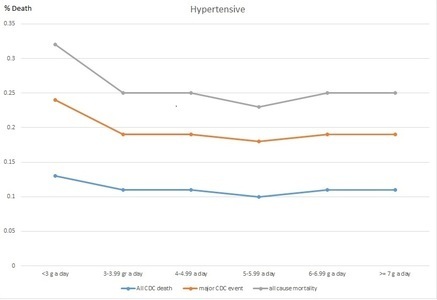
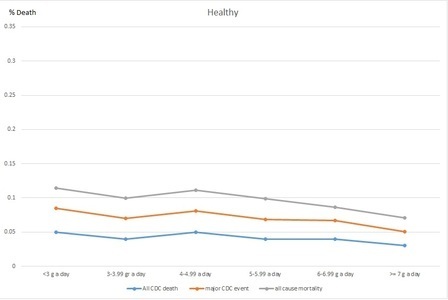
In order to fully illustrate the findings in this study (Associations of urinary sodium excretion with cardiovascular events in individuals with and without hypertension: a pooled analysis of data from four studies), I created two charts using their data.

Figure 1. Death rates per sodium change in hypertensive patients

Hypertensive death per sodium change

Figure 2. Death rates per sodium change in healthy individuals

Healthy Subjects Death per Change in Sodium

While Figure 1, shows the hypertensive and diabetic patients with a mixed curve-like relation to urinary salt, Figure 2 shows that healthy individuals tend to remain healthier the more salt they have in their urine. The two graphs show that both groups (healthy and hypertensive) tended to die or have cardiac events when less urinary salt was found. Thus, we may conclude that too little urinary salt is unhealthy and that for the healthy, the more salt in the urine the better. Do we know why the unhealthy had low or high urinary salt? No clue. Do we know why the healthy had low or high urinary salt? Nope. Can we conclude anything at all? Yes: in both groups, less urinary salt found in the urine meant earlier death.

The authors of the article did not publish these simple graphs. Why not? Perhaps because these graphs show that the data of the sick and the healthy cannot be combined. Instead, they ran a regression that cancels these differences to some degree, with which the whole article passes on a very confused message. Unfortunately, since The Lancet is the top academic journal, every single medical practitioner, cardiologist, and nutritionist who may gain some insight from an article like this will put it down and head for a walk instead.

These findings could have been important if properly analyzed, since they would represent a paradigm shift in medical understanding of the role of salt in our diet, why the sick are getting sicker and those on low salt diet die faster!

My Take on the Research

The study was flawed from the onset.

  1. The database they used, PURE, has data from thousands of individuals for general epidemiological analysis and so the control mechanism to conclude any causal relationship is impossible. In particular, reading salt amount in morning fasting urine samples tells nothing about how much salt the individual consumed the day before let alone in general. One cannot conclude a meaningful association between salt amount in urine and salt amount consumed because there are so many factors interfering with the clearance of salt from the body (1-9). Even correlation is dubious; deriving causation is impossible, yet that is precisely what this paper did.
  2. The authors combined findings of the sick and the healthy, regardless of what heart or diabetic medications the sick were taking (both alter urinary salt content), and created a combined graph representing the recommended daily dietary intake for all people (sick, healthy, children, elderly).

Back to the Perils of Academic Publishing

I wrote a commentary about the flaws and sent it to The Lancet. It was rejected after the editors sat on it for over two months. Why was it rejected? Interestingly, while most academic articles are followed by comments and debates, The Lancet did not allow any comments for or against this particular article. This is odd since without a healthy debate, science heads nowhere. When researchers discover errors or flaws and cannot publish these finding, less discerning readers will continue to misunderstand the research. In this case, most will think that less salt is better for cardiovascular health, when it is absolutely not.

References

  1. Unger T & Jun Li (2004) The role of the renin-angiotensin-aldosterone system in heart failure. Journal of Renin-Angiotensin-Aldosterone System 5(1 suppl):S7-S10.
  2. McQuarrie EP, et al. (2014) Association Between Urinary Sodium, Creatinine, Albumin, and Long-Term Survival in Chronic Kidney Disease. Hypertension 64(1):111-117.
  3. Christensen BM, et al. (2010) Sodium and Potassium Balance Depends on αENaC Expression in Connecting Tubule. Journal of the American Society of Nephrology : JASN 21(11):1942-1951.
  4. Ragot S, et al. (2016) Dynamic Changes in Renal Function Are Associated With Major Cardiovascular Events in Patients With Type 2 Diabetes. Diabetes Care 39(7):1259-1266.
  5. Mannucci E, et al. (Cardiac safety profile of rosiglitazone. International Journal of Cardiology 143(2):135-140.
  6. Longo DL, et al. (2013) Harrison’s Manual of Medicine 18th Edition (McGraw Hill Medical, New York).
  7. DiNicolantonio JJ & Lucan SC (2014) The wrong white crystals: not salt but sugar as aetiological in hypertension and cardiometabolic disease. Open Heart 1(1):e000167.
  8. Verbalis JG (Disorders of body water homeostasis. Best Practice & Research Clinical Endocrinology & Metabolism 17(4):471-503.
  9. Catterall WA (2000) From ionic currents to molecular mechanisms: the structure and function of voltage-gated sodium channels. Neuron 26.


Himalayan Salt – Flint on Global Scale?

103K views

Over dinner last night,  CNN news brought the Flint, Michigan, lead poisoning in water up for a closer look and discussion. Dr. Sanjay Gupta visited a family and discussed the problems in great detail from the medical point of view. One particular sentence caught my attention: 5 parts of lead per billion is a health concern. Five parts in a billion is a very small number but I remembered Himalayan salt spectral analysis that has a table on its website about Himalayan salt–among other things we eat.

I noted that the lead in Himalayan salt is 0.10 ppm (parts per million), so how much is that in a billion? There are 1000 millions in a billion so 0.10 * 1000 = 100 ppb. This means that while 5 ppb is of health concern in Flint and is getting kids and adults sick, Himalayan salt has 100 ppb! That is twenty times as large lead-dose than what is harming people in Flint, Michigan.

100 ppb Lead in Himalayan Salt

In the past few weeks, I have participated in many discussions (some not so nice) in various Facebook groups about the so called benefit of the many “minerals” of using Himalayan salt. Well, I wonder if getting twenty times the dose of what is considered to be unsafe in lead consumption is considered to be a healthy mineral or if it will now silence the opposition.

While I understand that eating salt is small in quantity relative to drinking water, why eat salt with lead when we can choose salt without lead? Himalayan salt also has mercury. There is no safe level of mercury for humans. The safe level is zero. Himalayan salt has additional wonderful radioactive elements in it like plutonium and uranium and about fifty others like it. Does anyone like radioactive materials to eat?

I do not wish to bore anyone with any mathematics since how much lead or mercury one eats a day is really irrelevant. What is extremely relevant though is that lead is heavy metal and heavy metals in your body remain for life. There is absolutely nothing we can do to remove lead from the body with our current medical acumen. If you choose to continue to eat Himalayan salt, lead (and mercury and all radioactive heavy metals) will continue to deposit in your body. At one point it will reach the level at which time you will get sick.

Note I did not write you might get sick but wrote that you will reach dangerous levels at which point you will start noticing illness.

Symptoms of lead poisoning are:

Neurological Effects

  • Peripheral neuropathy
  • Fatigue / Irritability
  • Impaired concentration
  • Hearing loss
  • Wrist / Foot drop
  • Seizures
  • Encephalopathy

Gastrointestinal Effects

  • Nausea
  • Dyspepsia
  • Constipation
  • Colic
  • Lead line on gingival tissue

Reproductive Effects

  • Miscarriages/Stillbirths
  • Reduced sperm count & motility
  • Abnormal sperm
  • Heme Synthesis
  • Anemia
  • Erythrocyte protoporphyrin elevation

Renal Effects

  • Chronic nephropathy with proximal tubular damage
  • Hypertension
  • Arthralgia
  • Myalgia

To find out the full spectrum of conditions lead poisoning can cause and how to prevent it (other than stop eating Himalayan salt), follow this link.

If you feel you may have lead poisoning, please call this number:

1 (800) 222-1222 American Association of Poison Control Centers

For your health: please stop eating Himalayan salt. If you can avoid a tragedy, do.

Comments and questions are welcome.

Angela

Amendment

Since I published this article, the FDA has posted warnings against using chelated OTC medications. The following is the FDA warning published today:

“The U.S. Food and Drug Administration (FDA) is reminding consumers to be wary of so-called “chelation” products that are marketed over-the-counter (OTC) to prevent or treat diseases such as lead poisoning. These products are not FDA approved.

Chelation involves the use of certain chemicals to remove heavy metals from the body. In medicine, chelation has been used for the treatment of metal poisoning, among other conditions.
FDA has never approved any chelation product for OTC use for any health condition. All FDA-approved chelation products require a prescription because they can only be used safely under the supervision of a health care practitioner.
Illegal OTC chelation products are frequently marketed to deceive consumers into thinking they are taking a product that has been evaluated by FDA. Companies that make unapproved products often highlight that their product contains the same ingredient as an FDA-approved drug, suggesting that it is OK for them to market their drug without FDA approval. However, this is not permitted. Under FDA law and regulations, the company first must show that its product (whether or not it includes a previously-approved drug) is safe and effective before it may be marketed. The OTC chelation products have not been subject to the rigorous approval process and manufacturing scrutiny required for FDA-approved products, and are therefore not being legally marketed.
For more information please visit: Chelation
I felt it important to post this update in light of some of the comments that suggests that chelation removes heavy metals from the body. Apparently the FDA disagrees! Please take note!

We Need Your Help

More people than ever are reading Hormones Matter, a testament to the need for independent voices in health and medicine. We are not funded and accept limited advertising. Unlike many health sites, we don’t force you to purchase a subscription. We believe health information should be open to all. If you read Hormones Matter, like it, please help support it. Contribute now.

Yes, I would like to support Hormones Matter. 

Photo by Anastasia Zhenina on Unsplash.